
In our previous article, we looked at research showing that many breast cancer patients represented in Nigerian studies were diagnosed at advanced stages.
That raises an important follow-up question:
When a woman notices a breast change or is advised to undergo further assessment, how easy is it to reach the services needed to complete diagnosis?
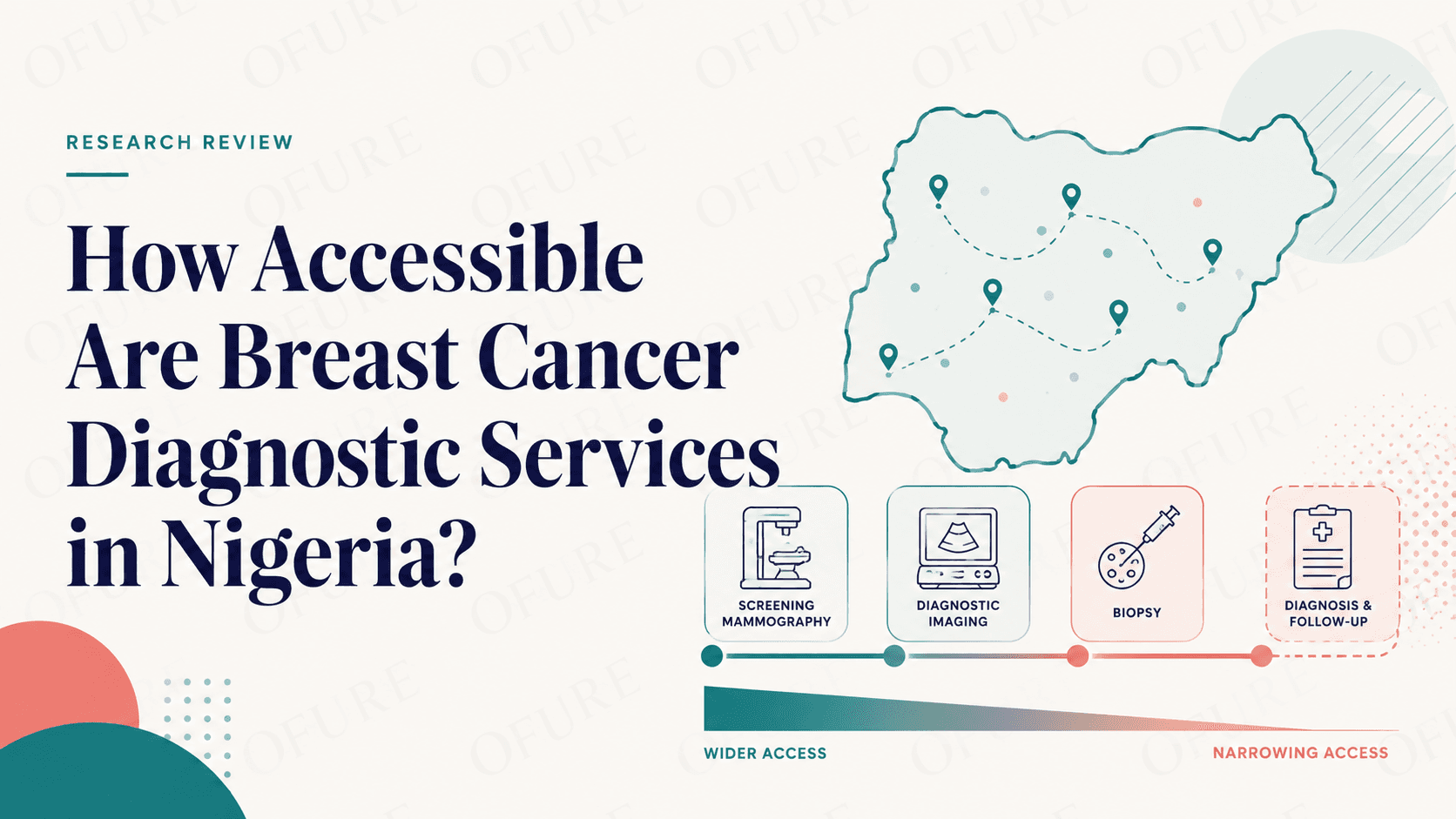
A 2023 study published in JCO Global Oncology examined this by mapping access to breast ultrasound, mammography and ultrasound-guided breast biopsy services across Nigeria.
The study helps us look beyond awareness alone and ask a more practical question: are the services needed for early diagnosis actually within reach, and does access remain the same as a patient moves from imaging to biopsy and onward care?
What did the researchers examine?
The study, titled Population-Level Access to Breast Cancer Early Detection and Diagnosis in Nigeria, assessed the geographical distribution of facilities offering three important breast diagnostic services:
breast ultrasound
mammography
ultrasound-guided breast biopsy
The researchers combined publicly available facility information with a national survey of Nigerian radiologists. They then used a geographic information system, or GIS, model together with population and road-network data to estimate travel time to the nearest service.
This distinction is important.
The study measured potential geographical access. It did not determine whether every person could afford the service, whether equipment was functioning when needed, how long patients waited, or whether they ultimately completed diagnosis.
2. What did the study find?
The researchers identified 1,336 facilities offering breast ultrasound across Nigeria and 218 facilities offering mammography. All of the mammography facilities identified also offered ultrasound.
The number dropped considerably when the researchers looked at biopsy.
Only 33 of the 1,336 facilities offering breast ultrasound also provided ultrasound-guided breast biopsy. That represented just 2.5% of the ultrasound facilities identified.
At population level, the researchers estimated that 83.1% of Nigerians lived within 120 minutes of either breast ultrasound or mammography.
For ultrasound-guided breast biopsy, the corresponding estimate was much lower, at approximately 62% within 120 minutes of continuous one-way travel.
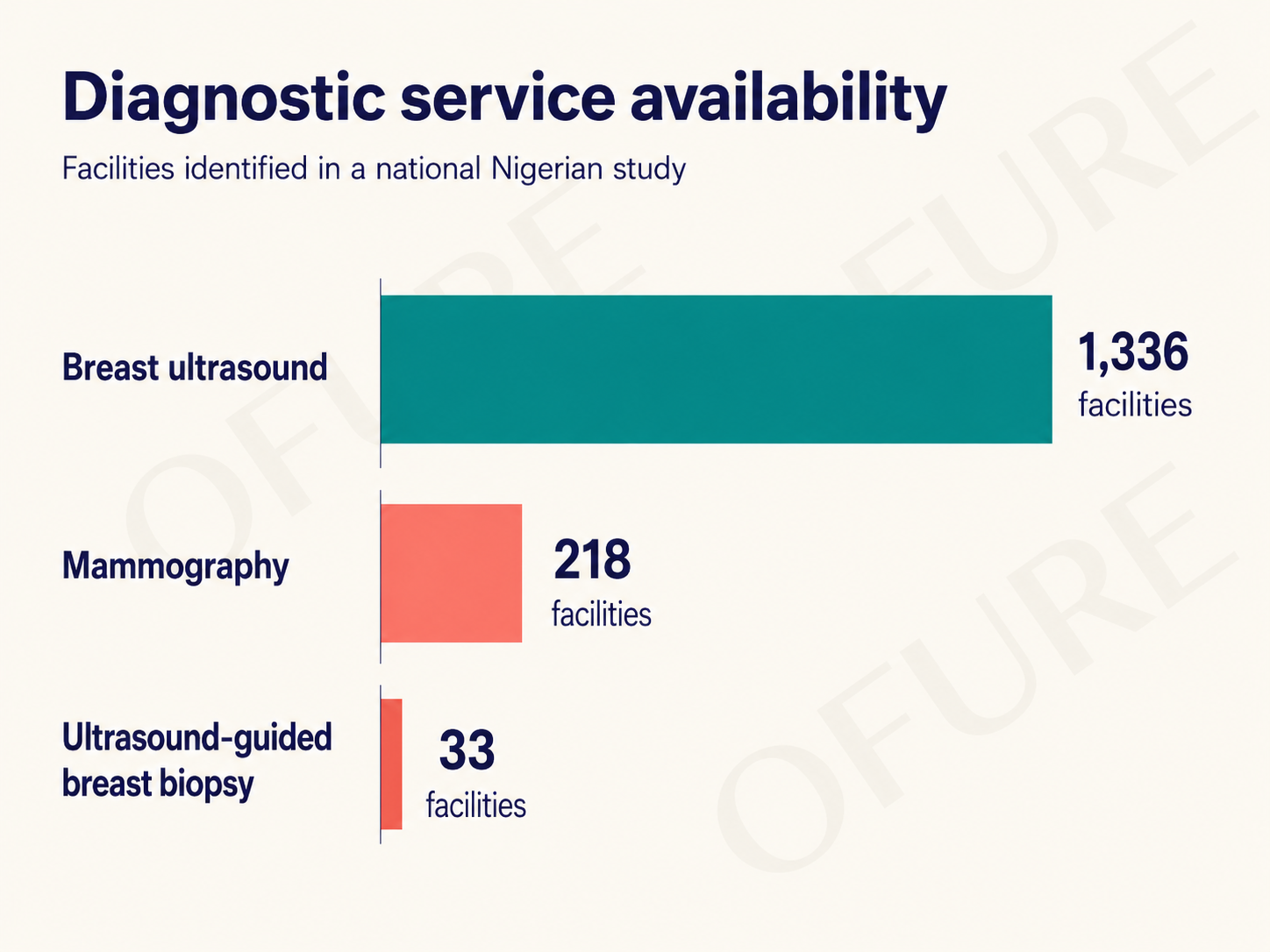
There were many more facilities able to perform imaging than facilities able to perform an ultrasound-guided biopsy.
Why does the biopsy gap matter?
Breast imaging can help healthcare professionals investigate a breast concern, but imaging does not always provide a final diagnosis.
Where a suspicious abnormality is identified, a clinician may recommend a biopsy so that tissue can be examined. The study itself notes that establishing a pathological diagnosis requires biopsy.
This means that access can narrow as a patient moves through the diagnostic journey.
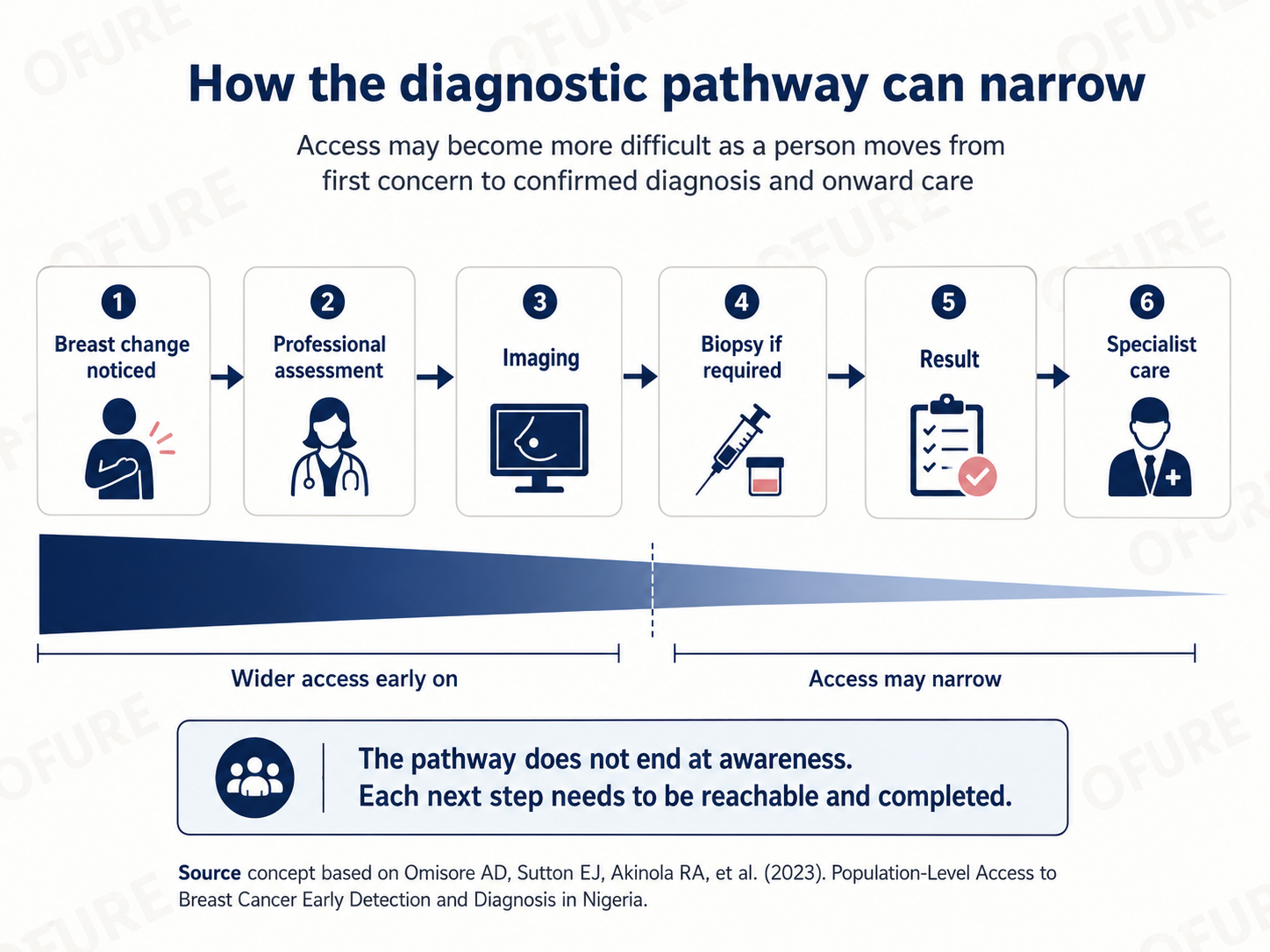
A woman may therefore live reasonably close to a facility offering breast ultrasound but still need to travel considerably further if a biopsy is subsequently recommended.
This is why access should not be understood as a single event.
The important question is whether the person can complete every necessary step.
Access is not equal across Nigeria
The study also found substantial geographical inequalities. For mammography, the researchers estimated that 80.6% of people in southern Nigeria lived within 120 minutes of a facility, compared with 64.8% in northern Nigeria. The difference was also evident for ultrasound-guided biopsy. At 120 minutes, estimated access was 77.1% in southern Nigeria and 49.0% in northern Nigeria.
Some differences were even more pronounced when individual geopolitical zones were examined. For example, estimated mammography access within 120 minutes ranged from 85.1% in the South East to 57.9% in the North East.
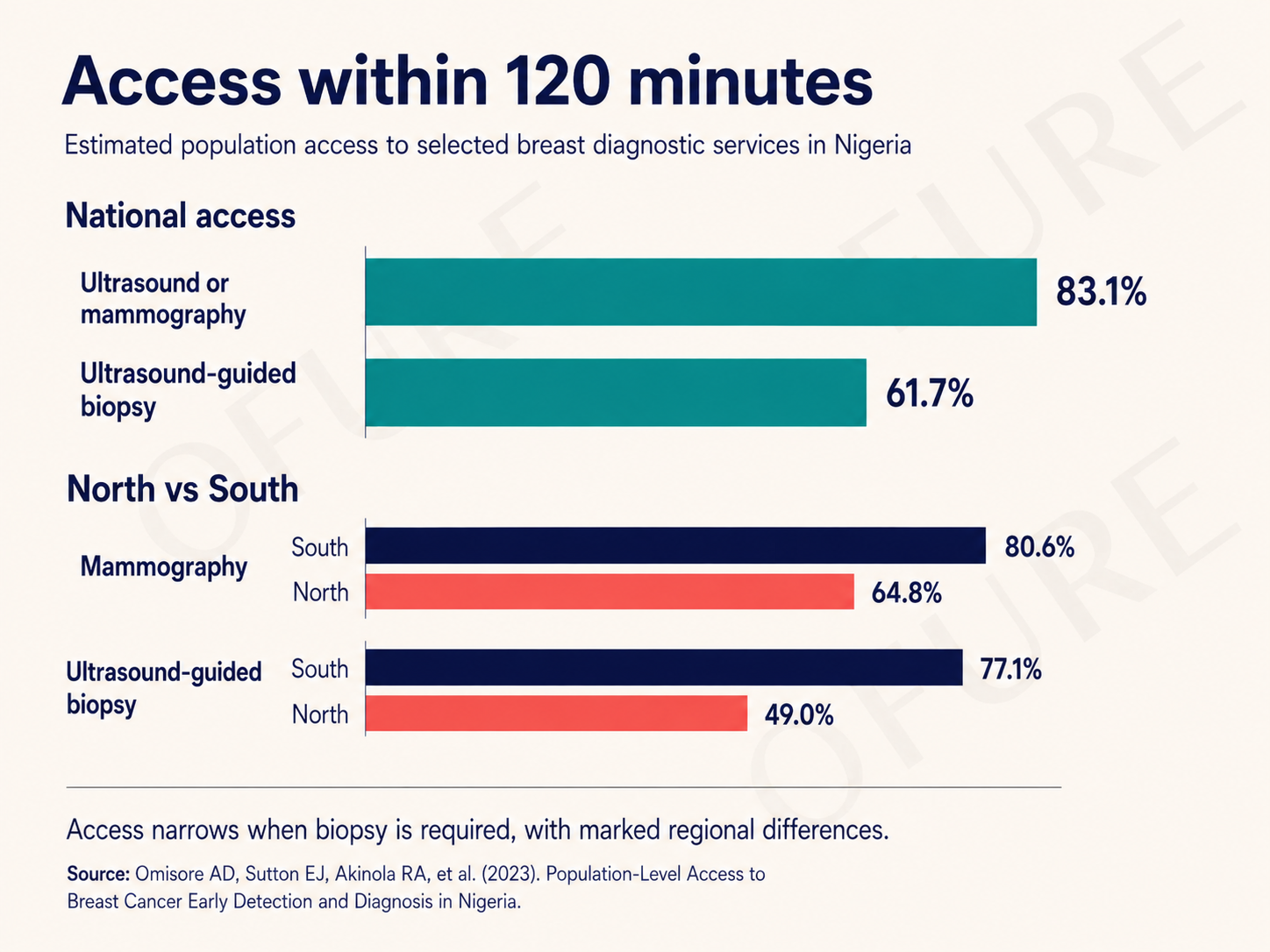
The authors concluded that northern Nigeria, particularly the North East, should be prioritised for targeted investment in diagnostic infrastructure and training.
National averages can therefore hide important local inequalities.
What does the study not tell us?
One of the most important things about interpreting this research is understanding what the figures do not represent.
Living within two hours of a facility does not necessarily mean that a patient can easily use the service.
The researchers themselves acknowledge that diagnostic services can be disrupted by problems such as power outages, shortages of trained personnel and equipment maintenance. They also note that their facility data represented a particular point in time and that some facilities may not have been captured.
The study also does not establish whether a patient:
can afford the test
can afford the transport required to reach it
can obtain an appointment quickly
receives the result promptly
understands what the result means
is successfully referred onwards
completes any additional investigation or treatment required
A two-hour estimate also represents continuous one-way travel.
For someone travelling in real life, the journey may involve waiting for transport, poor road conditions, traffic, time away from work, childcare responsibilities and repeated visits.
So the study provides valuable evidence about where services are located relative to the population, but it does not tell us whether the entire patient journey is accessible.
What do the findings mean for early diagnosis?
The study provides an important insight.
Nigeria appears to have relatively widespread geographical access to breast ultrasound, and more than four in five people were estimated to live within two hours of either ultrasound or mammography.
But the diagnostic pathway becomes less accessible when a biopsy is required.
This suggests that improving breast cancer early diagnosis is not only about increasing awareness or encouraging women to seek help.
The health system must also be able to support what happens after someone seeks help.
That includes appropriate assessment, imaging where recommended, biopsy where necessary, return of results, referral and timely specialist care.
A failure at any one of these points can interrupt the journey.
What should individuals take from this research?
Anyone who notices a new or unusual breast change should seek assessment from a qualified healthcare professional.
Depending on the individual circumstances and professional assessment, further investigation may include ultrasound, mammography or another test. A biopsy may be recommended where additional investigation is necessary.
If further assessment is advised, useful questions include:
What test or assessment do I need?
Where can I complete it?
Do I need an appointment or referral?
What should I bring with me?
When should I expect the result?
Who will discuss the result with me?
What happens next if another assessment is required?
Receiving a recommendation or referral is only one part of the process.
Where possible, the next step should be completed and followed through until there is a clear outcome and plan.
The Ofure perspective
This research highlights an important distinction between services existing and people being able to complete a journey through those services.
A person may have access to an imaging facility but still struggle to identify where a biopsy can be completed, understand a referral, keep track of appointments, retain documents or know what should happen after a result.
This is closely connected to the problem Ofure is being developed to address.
Ofure aims to help individuals and families understand the next health action, connect with an appropriate service and remain supported through preventive care, assessment, referrals and follow-up.
Ofure does not diagnose breast cancer, decide which clinical investigation someone requires or interpret diagnostic results. Those decisions remain with qualified healthcare professionals.
The wider lesson
The study provides encouraging evidence that breast diagnostic imaging is geographically within reach of a large proportion of Nigeria's population.
At the same time, it reveals significant gaps.
Ultrasound-guided biopsy was available at only a small proportion of the ultrasound facilities identified, and access differed substantially between northern and southern Nigeria.
The lesson is therefore not simply that Nigeria needs more screening or more awareness.
It needs connected diagnostic pathways.
The real measure of access is not only whether a service exists. It is whether a person who needs care can move from the first concern to the appropriate assessment, complete any necessary tests, receive the result and reach the next stage of care.
That is the journey that ultimately needs to work.
Omisore AD, Sutton EJ, Akinola RA, Towoju AG, Akhigbe A, Ebubedike UR, et al. (2023). Population-Level Access to Breast Cancer Early Detection and Diagnosis in Nigeria. JCO Global Oncology, 9, e2300093. https://doi.org/10.1200/GO.23.00093
This article provides general educational information and should not be used as a substitute for professional medical advice, diagnosis or treatment. Anyone who notices a new or unusual breast change should seek assessment from a qualified healthcare professional.