
Breast cancer outcomes are influenced not only by the type of cancer and the treatment available, but also by the stage at which the disease is diagnosed.
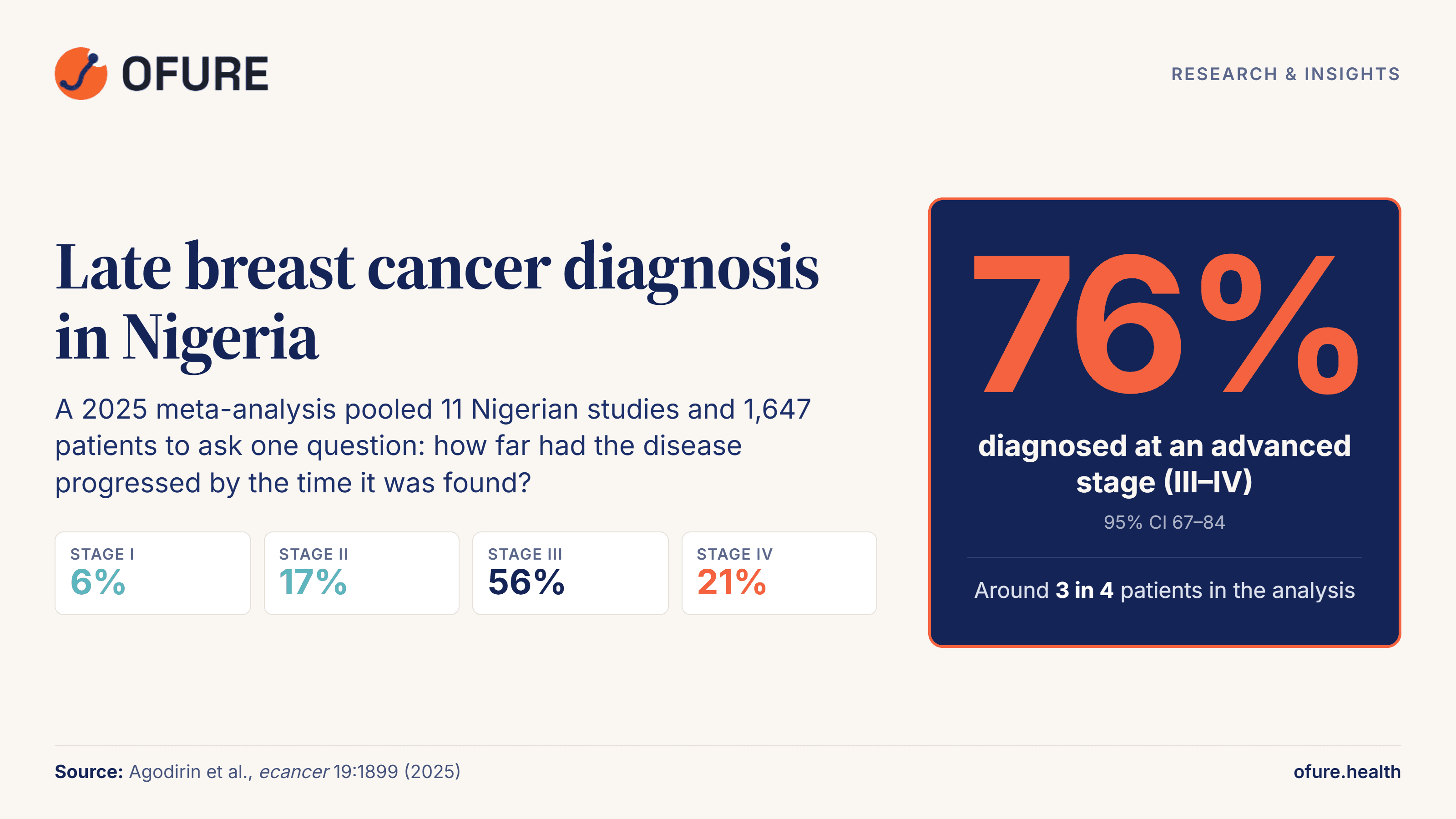
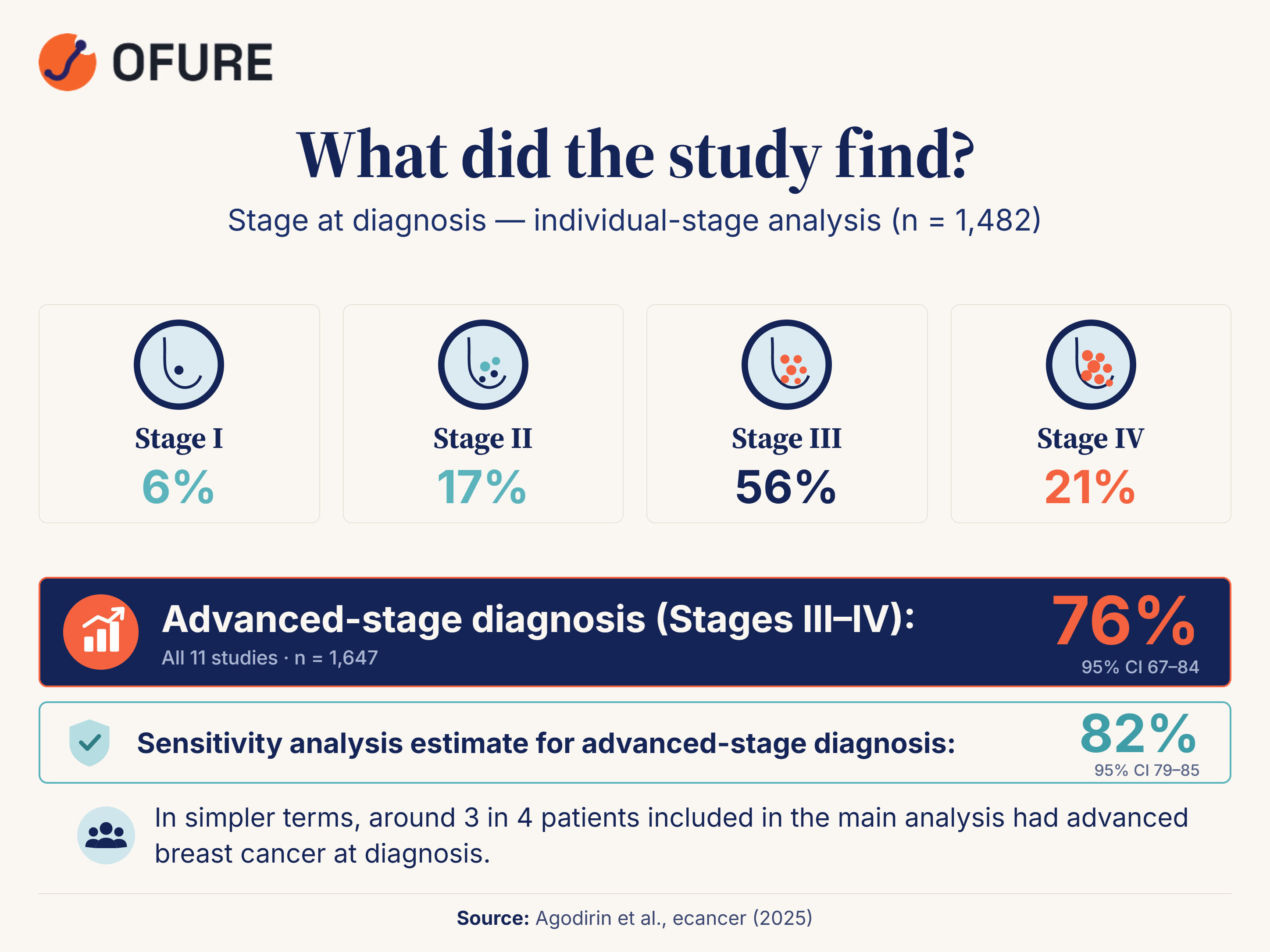
A 2025 meta-analysis published in ecancer examined the stages at which breast cancer patients were diagnosed across research published between 2018 and 2023. Its findings suggest that advanced-stage diagnosis remains a serious challenge in Nigeria. Across 11 studies and 1,647 patients, 76% were diagnosed at an advanced stage — Stage III (56%) or Stage IV (21%). Only 6% were diagnosed at Stage I.
The study does not explain every reason behind delayed diagnosis, and its results should not be treated as a precise estimate for every woman in the country. However, it offers important evidence about where many patients represented in Nigerian hospital studies are entering the breast cancer care journey.
What did the researchers examine?
The paper, Nigeria’s 6-year (2018–2023) stage distribution of breast cancer at diagnosis: a systematic review and meta-analysis, brought together findings from 11 studies involving 1,647 breast cancer patients.
Rather than recruiting a new group of patients, the researchers reviewed existing Nigerian studies and combined their results statistically. Their aim was to examine the recent distribution of breast cancer stages at diagnosis and compare it with earlier evidence.
What does advanced-stage diagnosis mean?
Breast cancer stages describe how much the cancer has grown and whether it has spread.
Stages I and II are generally described as earlier stages. Stage III means the cancer has spread more extensively within the breast, chest wall, skin or nearby lymph nodes. Stage IV means it has spread to another part of the body.
These are simplified descriptions. A person’s treatment options and outlook depend on several factors, including the characteristics of the cancer, general health, access to treatment and response to care. Cancer staging should always be explained by a qualified healthcare professional.
What does the study not tell us?
The findings do not necessarily mean that exactly 76% of all Nigerian women with breast cancer are diagnosed at an advanced stage.
The figure represents the combined results of the studies that met the researchers’ inclusion criteria. Many of the studies used information from hospitals and specialist facilities, so the patients represented may not reflect every breast cancer case across Nigeria.
The researchers also found substantial differences between the included studies, and some of the estimates had wide confidence intervals. The paper therefore gives a strong indication that advanced-stage diagnosis remains common, but it also highlights weaknesses in the available national data.
The study examined the stage at diagnosis. It did not directly establish why each patient reached care at that stage.
Why might diagnosis happen late?
It would be unfair to assume that advanced-stage diagnosis happens only because women ignore symptoms or wait too long before seeking help.
Delay can occur at several points in the journey. A woman may notice a change but be unsure whether it requires attention. After seeking help, she may still need to obtain a clinical assessment, imaging, a biopsy, pathology results, a referral and specialist review.
Cost, transport, appointment availability, communication, fear, previous healthcare experiences and limited service capacity may affect different stages of that journey.
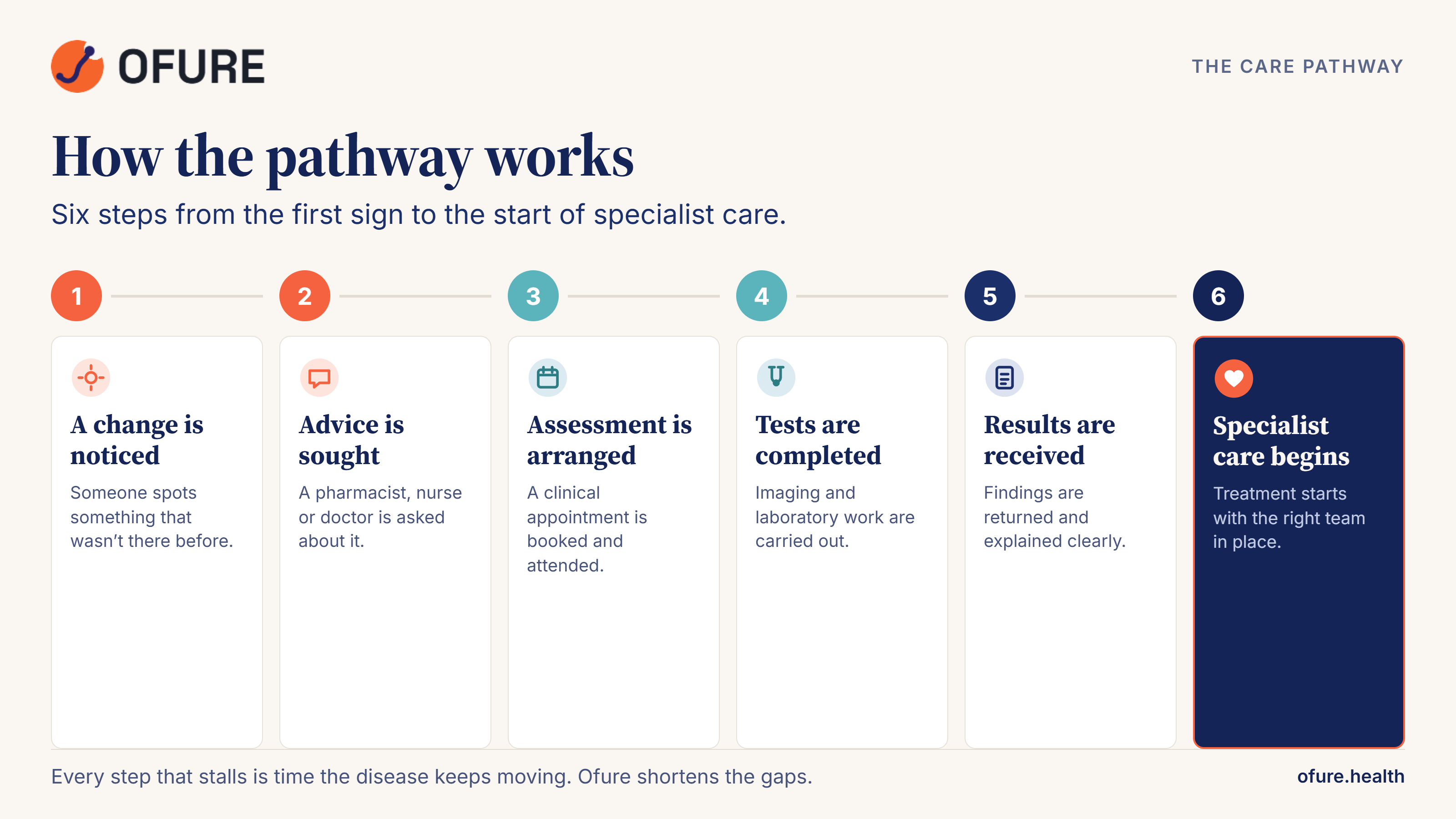
A delay or breakdown at any point can extend the time before a confirmed diagnosis and appropriate treatment.
What should readers take from the research?
The appropriate response is not panic or assuming that every breast change is cancer. It is also not a recommendation that every woman should undergo the same screening test. The practical message is that a new or unusual breast change should not be ignored simply because it is painless.
Changes that may require professional assessment include a new lump or swelling, a change in breast size or shape, nipple changes, unusual discharge, persistent skin changes or anything that feels different from what is normal for the individual.
Most breast changes are not cancer. But only a professional assessment can tell you which ones need further investigation. Seeking help is also only the beginning. Where imaging, biopsy, referral or follow-up is recommended, completing those next steps is important.
The Ofure perspective
Ofure’s Cancer Prevention and Early Detection module is being developed to support breast awareness, appropriate assessment, referral navigation and follow-up.
Ofure will not diagnose breast cancer, interpret biopsy results or recommend treatment. Those responsibilities remain with qualified healthcare professionals.
Its role is to help individuals understand the next action, identify an appropriate service, keep track of appointments and referrals, and remain supported as the journey continues.
The lesson from this research is not simply that many patients are reaching care late. It is that earlier action must be supported by a healthcare journey people can actually complete.
Noticing a change matters. Seeking help matters. Completing the next step matters too.
Take the next step
Have you noticed a new or unusual breast change, or have you been advised to complete an assessment, scan, biopsy or follow-up appointment? Speak with a qualified healthcare professional and complete the recommended next step promptly.
This article explains findings from published research and provides general health information. It is not a substitute for medical advice, diagnosis or treatment.
Speak with a qualified healthcare professional about any new or unusual breast change. Seek prompt medical attention if you have a concerning symptom or have been advised to complete further assessment or follow-up.
Agodirin O, Chijioke C, Mustapha F, Rahman G, Olatoke S, Olaogun J and Akande H. (2025). Nigeria’s 6-year (2018–2023) stage distribution of breast cancer at diagnosis: a systematic review and meta-analysis. ecancer, 19, 1899. https://ecancer.org/en/journal/article/1899-nigerias-6-year-2018-2023-stage-distribution-of-breast-cancer-at-diagnosis-a-systematic-review-and-meta-analysis